Utility Leak Notice? How We Handle Underground Line Leaks
Got a utility notice about a hidden underground water leak? Learn the exact steps, costs, and what to expect from professional leak locating services.
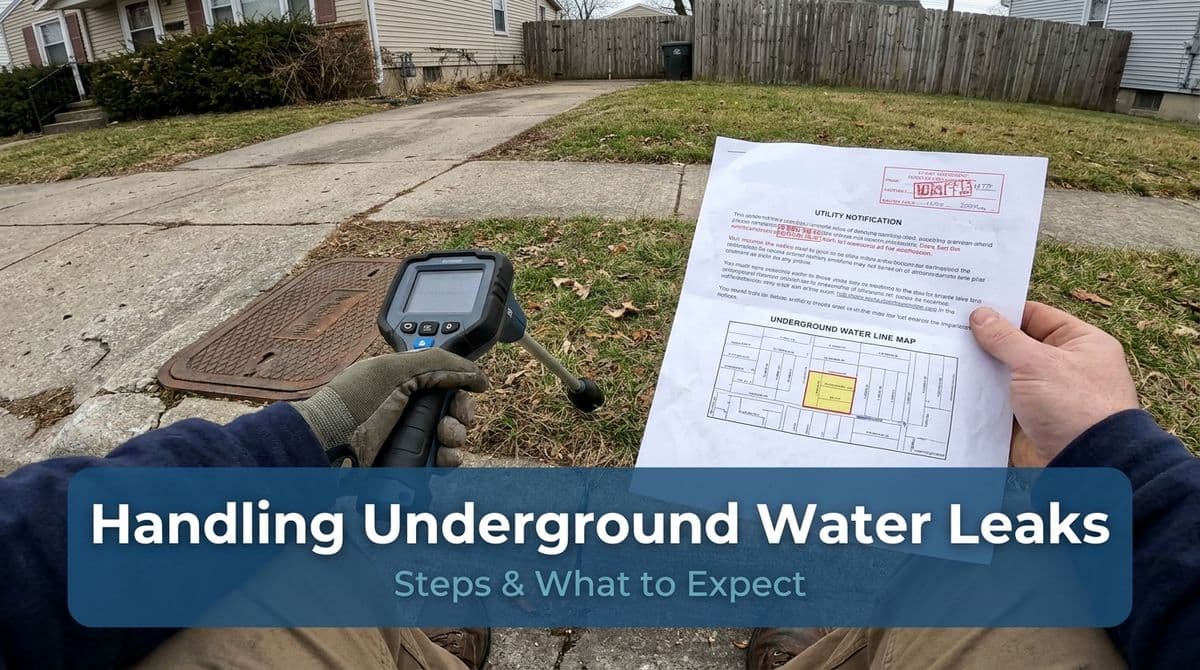
What To Do After a Utility Leak Notice on Your Water Line
We recently got a call from a homeowner — let’s call him Mark — who had just received one of those dreaded notices from his water provider. The utility had run a usage check and told him he was losing about 35 gallons an hour from his service line. No water in the house, no visible puddles in the yard… but a steady, expensive leak somewhere underground.
Mark’s first question was simple: “What do I do now?” We walked him through the process step by step — from that first utility notice to leak locating, costs, and what to expect when we come out. In this post, we want to share that same guidance with you.
Step 1: Don’t Panic, But Don’t Ignore the Notice
When a utility flags a leak, it’s usually because their system shows continuous water use — often measured in gallons per hour, like Mark’s 35 gallons. That adds up fast on your water bill and can slowly damage your property.
Most underground leaks:
- Are on the service line between the meter and the house
- Do not show obvious surface water, especially in dry or rocky soil
- Will keep running 24/7 until the line is shut off or repaired
The notice is your early warning. You usually have a little time to schedule help, but it’s important not to put it off for weeks or months, especially with a high leak rate.
Step 2: Simple Checks You Can Do Before Calling Us
Before you schedule leak locating, there are a few safe checks you can do that sometimes rule out simpler issues inside the home:
Confirm the Leak Is on the Service Line
Here are some homeowner-friendly steps (no digging, no tools beyond a flashlight):
- Turn everything off inside: Make sure all faucets, showers, irrigation, and appliances are off.
- Check toilets: Listen for hissing, and add a few drops of food coloring to the tank. If it seeps into the bowl without flushing, that toilet is leaking.
- Look at your water meter (if accessible): Many meters have a small triangular or star-shaped “leak indicator.” If it’s spinning while everything is off, water is still moving.
- Shut your main house valve (if you know where it is): With the main to the house off, check the meter again. If the indicator still moves, the leak is likely between the meter and the house — that’s your underground service line.
If any of this feels confusing or your meter is hard to access, don’t worry — we handle this assessment on site. But these checks can give you a head start and good information to share when you call.
Step 3: Call Your Water Provider With the Right Questions
Mark’s utility had already told him his exact leak rate — 35 gallons an hour. Not every provider volunteers that level of detail right away, so it’s helpful to know what to ask:
- “What is my estimated leak rate?” (gallons per hour or per day)
- “Does your data show the leak is on my side of the meter?”
- “Do you offer any leak adjustment on my bill after repairs?”
- “Do you require any inspection or documentation from the plumber?”
Having these answers helps us plan the visit and gives you an idea of how urgent the situation is financially and practically.
Step 4: What Leak Locating Service Actually Involves
When Mark called us, his biggest concerns were cost and logistics. We explained how our leak locating process usually works for a residential water line like his:
Typical Time Window
We usually schedule leak locating in a 3–4 hour time block. That doesn’t always mean we’re digging for four hours; it just allows time for:
- On-site assessment and shutoff coordination
- Setting up our locating equipment
- Tracing the service line and pinpointing the leak
- Documenting what we find and discussing repair options
Typical Cost Range
For most residential underground water line leaks, Mark’s quote is a good guideline: leak locating usually runs between about $775 and $950, depending on:
- How long it takes to find the leak
- How deep the line is
- Soil and surface conditions (rock, concrete, landscaping, etc.)
- How complex the piping layout is
That fee covers the expertise and specialized tools to find the problem without unnecessary digging. The actual repair is a separate cost, and we explain options once we know exactly where the line has failed.
Step 5: What We Need Access To (And Why We Don’t Always Need the House)
Mark needed to leave town in a couple of days and was worried we’d need to get inside the house. In many cases, we don’t. For a typical underground service line leak, what we really need is:
- Access to the main shutoff: Either at the meter or an exterior valve, so we can safely turn water off and on.
- Clear access to the yard or driveway areas: Where the service line most likely runs.
- Space to set up equipment: For acoustic listening, tracing, or camera work, depending on the system.
As we told Mark, if we can shut the water off from outside and access the line to run our locating equipment or a camera, we usually do not need to enter the home. That flexibility can be a big relief if you’re on a tight travel schedule.
Step 6: How We Coordinate Scheduling Around Your Plans
One of Mark’s challenges was timing. Our crews were on a few large projects, some technicians were on vacation, and he was heading out of town midweek. That’s real life, and we try to work around it as best we can.
Here’s how we typically handle it:
- We look at our active project list: to see when a leak locating specialist can break away.
- We ask about your availability window: especially if you’ll be gone for several days.
- We prioritize higher-rate leaks: like Mark’s 35 gallons an hour, because they’re more costly and potentially more damaging.
- We note whether house access is needed: if not, we often have more flexibility to schedule while you’re away.
Sometimes, like with Mark, we’ll confer internally, then call back once we know which day and time block we can commit to. We’d rather be honest about our schedule than overpromise and leave you waiting.
What Happens After We Locate the Leak
Leak locating is about finding the exact where and often the likely why — for example, a break in an older copper line, a failed fitting, or damage from roots or shifting soil. Once we’ve pinpointed the spot, we walk you through:
- Repair options: spot repair vs. partial or full line replacement
- Expected repair costs and timelines
- Surface restoration considerations: landscaping, concrete, or hardscape we may need to cut and patch
- Any documentation you might need if your utility offers a bill adjustment
Every property is a little different, but the goal is always the same: stop the hidden leak as efficiently as possible and give you a clear picture of next steps and costs.
When You Get That Leak Notice, Here’s Your Game Plan
If your utility has just told you there’s a possible underground leak on your property, here’s a quick recap of how to handle it:
- Use your notice and any meter readings to confirm there’s likely a continuous leak.
- Do a few simple, safe checks inside (toilets, fixtures, meter if you can) to rule out obvious indoor issues.
- Call your water provider and ask about leak rate, location (their side vs. your side), and any post-repair bill adjustments.
- Schedule professional leak locating, understanding that residential locating typically runs roughly $775–$950 in our area.
- Coordinate access so we can shut off water at the meter or exterior valve — in many cases, we won’t need to come inside.
- Review repair options once we’ve identified where and why the line is leaking.
Underground leaks can feel mysterious and stressful, especially when they’re out of sight. With the right information and a clear process, you can move from “What is going on?” to “Here’s the plan” in a single visit — just like we did for Mark.