Sewer Lateral Line Test: What It Is and When You Need It
Wondering what a sewer lateral line test is and what it costs? Learn what it covers, when you need one, and why your address matters for accurate pricing.
What Is a Sewer Lateral Line Test?
We recently got a call from a homeowner — let’s call him Jason — who was trying to do exactly what a lot of people want to do: get a straight answer on the cost of a sewer line test.
Jason told us he needed a price “from the house to the main line” and then paused: “I believe that’s the lateral — would that be correct?” He also wasn’t sure why the office needed the address just to talk pricing.
Those are really common questions, especially for buyers, sellers, and real estate agents who are staring at inspection deadlines and just want clear information. So in this post, we’ll walk through what a sewer lateral line test is, what it covers, typical costs, and when you actually need one.
What Is a Sewer Lateral, Exactly?
When we talked with Jason, he knew there was a “main line” in the street and a pipe from his house, but the terminology was fuzzy. Here’s how we explained it.
Your home’s wastewater travels through a few different pieces of piping:
- Indoor drain lines – Smaller pipes from sinks, toilets, showers, etc.
- Main building drain – The larger pipe that collects everything inside the house.
- Sewer lateral – The pipe that runs from your home’s main drain out to the city sewer main or to a shared/private main.
The sewer lateral is usually underground, often under your yard, driveway, or even under the street right-of-way. In many cities, the homeowner is responsible for at least part of this line, sometimes all the way to the main in the street. That’s the section we test when you ask for a “lateral line test.”
What a Sewer Lateral Line Test Actually Covers
When Jason asked for a price “from the house to the main,” we confirmed: yes, that’s the lateral. But a lot of people don’t know what’s involved in testing it.
Depending on your local requirements and the property’s situation, a sewer lateral test can include:
- Locating and accessing the line – Finding cleanouts or other access points, sometimes removing a toilet or using a rooftop vent.
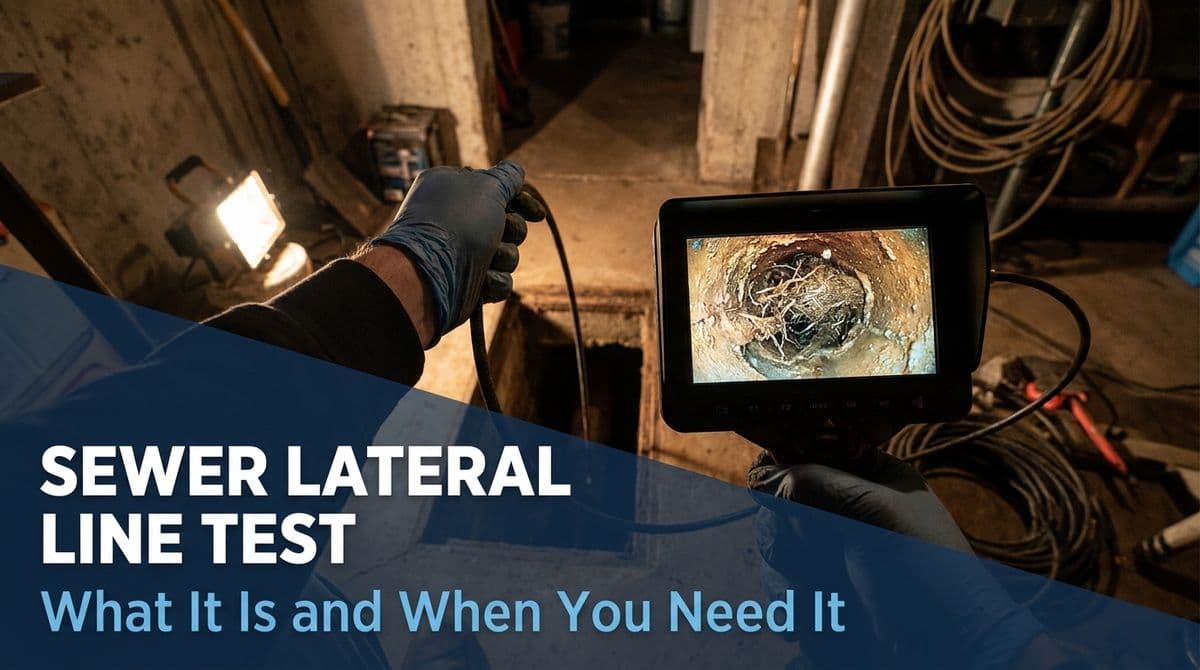
- CCTV camera inspection – Running a high-resolution camera through the line to visually check for cracks, bellies (sags), root intrusion, offsets, and blockages.
- Pressure or water test (pass/fail) – In some areas, a formal test is required for compliance, such as during a sale or remodel. The line is sealed and filled to a specified level to see if it holds without leaking.
- Condition report – A written summary, often with video or photos, describing the line’s condition and any repairs we recommend.
When you call us (like Jason did) and ask for a “sewer line test,” we’ll usually clarify whether you just need a condition check for peace of mind, or a formal pass/fail test for a city or utility sign-off. That helps us tailor the service and the price.
Why We Ask for Your Address Before Quoting Costs
On the call, Jason hesitated when we asked for the address. “I’m just trying to get a price,” he said — and we completely understand that feeling. But there’s a reason we ask.
Several factors affect the cost of a sewer lateral test:
- Local rules – Some cities require specific types of tests, permits, or official forms during property transfers.
- Access to the line – Easy-cleanout access near the house is cheaper than having to remove a toilet, dig, or work from the roof.
- Line length and slope – A short, straight run to the main is faster than a long, deep line with multiple turns.
- Property layout – Steep driveways, retaining walls, and limited access can affect setup time and equipment.
We plug your address into our system so we can see the jurisdiction, typical line layout in that area, and any known requirements. That’s how we give you an estimate that actually reflects your property, not just a vague ballpark.
Typical Cost Range for a Sewer Lateral Test
Every property is different, but in our area here’s what homeowners usually see:
- Basic camera inspection only: Often in the low-to-mid hundreds, depending on access and line length.
- Full compliance test (with pass/fail and paperwork): Typically higher, because we’re doing more setup, sealing, monitoring, and documentation.
- Additional charges: May apply for extreme access issues, locating buried cleanouts, or re-testing after repairs.
When we followed up with Jason, we were able to give him a clear quote based on his specific address and what the local requirements are for his area. That’s always our goal: no surprises, and no vague “it depends” answers if we can avoid them.
When Homeowners Should Get a Sewer Lateral Line Test
Jason was calling right around a real estate transaction, which is one of the most common triggers. But it’s not the only one. We usually recommend a sewer lateral test in these situations:
- Buying a home – Especially older homes or properties with large trees. A clean home inspection doesn’t guarantee a healthy sewer line.
- Selling a home – Some cities or utilities require a passing sewer lateral test before closing. Even when it’s not required, having documentation can prevent last-minute negotiations.
- Frequent backups or slow drains – If you’re calling for drain cleaning every year, the real problem may be in the lateral.
- Major remodels or additions – Adding bathrooms or increasing water usage is risky if your lateral is already marginal.
- Older clay, cast iron, or Orangeburg lines – These materials are more prone to cracking, collapsing, or root intrusion.
Think of the lateral line test as a health check for one of the most expensive and disruptive systems on your property. A failed test isn’t fun, but catching problems early usually gives you more options and time to plan repairs.
How to Prepare for a Sewer Lateral Test
If you decide to move forward with testing, there are a few simple ways to make the visit smoother:
- Locate any cleanouts – If you know where sewer cleanouts are (capped pipes sticking up a few inches), point them out when we arrive.
- Clear access paths – Move vehicles, trash cans, and yard items away from suspected line routes, especially driveways or side yards.
- Share any history – Past backups, root issues, or repairs help us focus on known weak spots.
- Have your paperwork handy – If the city or utility gave you specific test forms or requirements, we’ll want to see those.
From there, we handle the rest: setting up equipment, performing the test, documenting results, and explaining any next steps in plain language.
Not Sure If You Need a Test? Start With a Conversation
Jason’s first question was about cost, but underneath that was something else: “Do I really need this?” We walked him through the local rules, what the test would involve at his property, and what his options were depending on the results.
If you’re in a similar spot — buying, selling, or just worried about an older line — we’re happy to do the same for you. A quick call with your address and a bit of background is usually all we need to tell you:
- Whether a sewer lateral test is required or just recommended
- What kind of test makes the most sense
- A realistic cost range for your property
You don’t have to guess at terminology like “lateral” or “main,” and you don’t have to wait until a backup or a failed inspection forces your hand. With a little planning — and the right kind of testing — you can know exactly what’s going on underground before it becomes a much bigger problem.