Planning a Home Addition? Read This About Your Leach Field
Planning a home addition on septic? Learn how leach field expansions work, what permits you need, and realistic costs before you start building.
When a Home Addition Triggers a Septic Question
We recently got a call from a homeowner — let’s call him Brian — who was in the middle of planning an addition to his house. Brian’s septic system was basically brand new, the ground was already cleared, and he even had engineered plans drawn up. But there was one problem:
The leach field wasn’t sized for the extra bedrooms and the second structure he wanted to add.
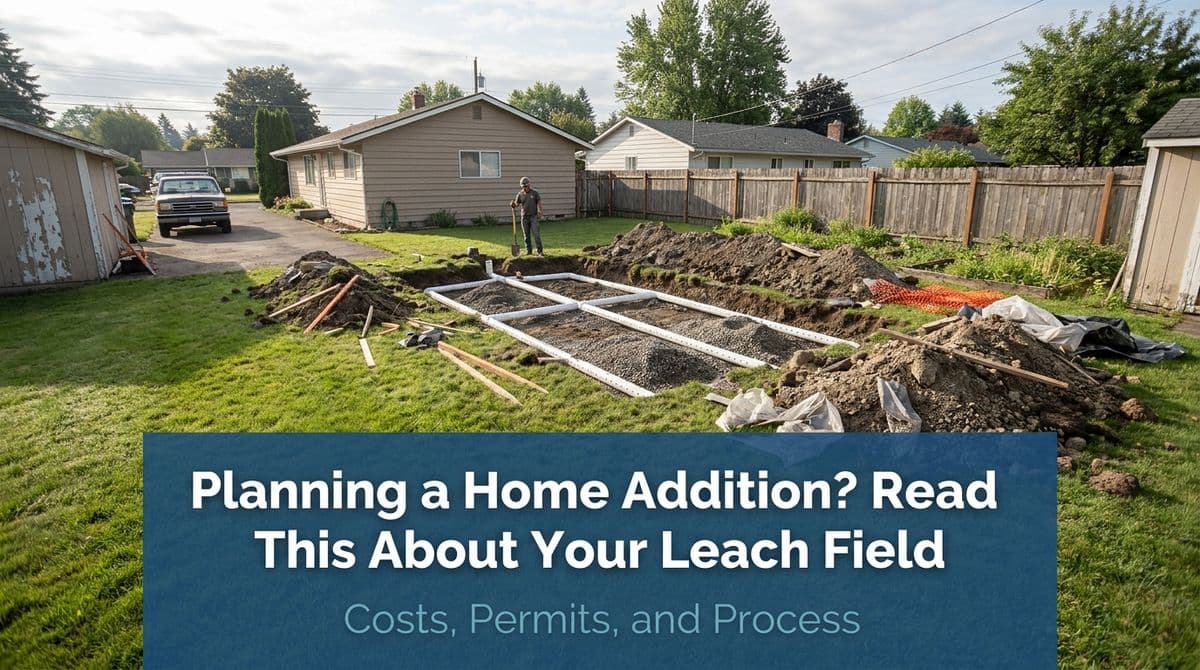
Brian told us his septic engineer had already submitted plans to the county to expand the field from two trenches to four, and he wanted a ballpark price from our team to install those extra lines and tie into his existing pump system. As we walked him through costs, permits, and the work involved, we realized he was asking the same questions we hear from a lot of homeowners planning additions.
So in this post, we’ll share how we think about leach field expansions — using Brian’s call as a real-world example — so you know what to expect before you start building.
Why a Home Addition Can Force a Leach Field Upgrade
When you add bedrooms, convert a basement, or build a second dwelling on your property, you’re not just adding square footage — you’re adding potential occupants and wastewater. Your septic system is sized based on things like:
- Number of bedrooms (or equivalent flow)
- Soil type and percolation test results
- Reserve capacity required by your county or state
In Brian’s case, the system was “basically brand new,” but it had been designed for the original house only. Once he started talking about “both houses and a potential addition,” the septic engineer had to recalc the flows and found the leach field needed two more trenches to meet code and protect the soil.
That kind of scenario is very common: the tank and pump may be fine, but the drainfield area has to grow with the home.
Permits and Plans: Who Does What?
One thing Brian did exactly right was getting an engineer involved early. By the time he called us, he already had stamped plans and an application submitted to the county. That meant we could focus on building instead of going back to the drawing board.
Typically, here’s how the permitting side works when you’re planning an addition:
- Septic designer/engineer evaluates soil tests, projected flows, and existing system capacity.
- They create a revised septic design that may include extra trenches, a new distribution box, or an upgraded pump tank.
- The plans are submitted to the county or state health department for approval, often alongside your building permit for the addition.
- Once approved, a licensed installer (that’s us) builds the expansion according to the plans and coordinates inspections.
With Brian, our first step after his call was to have him email us those engineered plans. Our office reviewed the layout, checked the proposed trench lengths, and confirmed how we’d tie into his existing pump lines before giving him a more precise estimate and schedule.
What It Actually Costs to Expand a Leach Field
On the phone, Brian asked what most homeowners want to know first: “Off the top of your head, what do you think this would cost?” For his project — two additional leach lines off an existing pressure-dosed system — we told him our rough ballpark was around $8,000.
That estimate included what we typically need for a job like his:
- 1–2 days of labor with a 3–4 person crew
- A small excavator and other equipment
- Additional pipe, valves, fittings, and gravel
- Chipping, compaction, and site cleanup
Actual costs vary based on factors like:
- Gravity vs. pump system (Brian’s was a pump system, which adds a bit of complexity and cost)
- Soil conditions — rocky, wet, or tight sites are slower to work in
- Access — how easily we can get machinery to the field
- Amount of new trench — more length means more labor and materials
We always start with a ballpark over the phone so you can see if it’s in the right range, then refine that once we’ve seen your plans or visited the site.
What Our Team Actually Does During a Leach Field Expansion
Once permits and plans are in place, our process on the ground is pretty straightforward, but there are a lot of steps behind the scenes. For a project like Brian’s, we typically:
- Review the approved design so we’re following your engineer’s specs and county requirements exactly.
- Locate and expose the existing lines from the pump or distribution box so we can see exactly how the current system is tied together.
- Install new valves and piping (Brian’s engineer called for new ball valves to manage flow to all four lines).
- Excavate and construct the new trenches to the depth, width, and length shown on the plans, with the correct gravel and pipe bed.
- Connect the new trenches into the system, double-checking slopes, elevations, and pressure distribution if it’s a pump system.
- Schedule inspections as required by the county before backfilling.
- Backfill and clean up the site, leaving the yard as tidy as we can given the excavation.
With Brian, we also walked him through where the new lines would sit on his property and how that might affect future landscaping and traffic areas. We always want homeowners to understand where the field is and how to protect it long-term.
How We Help You Plan a Leach Field Expansion
If you’re like Brian and starting to dream about more living space, we can step in at different points in the process. Our team can:
- Review your septic design with you so the engineer’s details make sense in plain language.
- Coordinate with your builder so septic work and the addition schedule don’t conflict.
- Advise on timing (for example, getting the field expansion done before you pour new driveways or patios).
- Flag access issues early if trees, fences, or retaining walls could block equipment.
In Brian’s case, he asked if we could get the work done in the next month or two. We checked our schedule, confirmed we had a window that matched his building plans, and moved forward to formalize the estimate after reviewing his engineer’s drawings.
Common Questions About Expanding Your Septic Leach Field
Can I build the addition first and deal with the septic later?
Usually, no. Most counties want the septic design approved as part of your addition permit, and lenders often require proof that the home has adequate wastewater capacity. It’s best to tackle design and approvals up front.
Do I always need a bigger field for an addition?
Not always. Sometimes the original system was sized generously, or your plans don’t actually increase the number of bedrooms. That’s why an engineer’s review is important before you assume anything.
Will I need a bigger tank too?
Maybe. In Brian’s situation, the tank and pump system were already sized well; only the leach field needed more capacity. In other cases, both tank and field must be upgraded to meet code.
Planning an Addition? Loop Us In Early
If an addition or second dwelling is on your mind, it’s worth a quick call before designs are finalized. We can help you and your engineer think through how your septic system fits into the bigger picture, give you realistic cost ranges, and make sure there are no surprises when it’s time to build.
That way, like Brian, you can move ahead with your project knowing your home — and your septic system — are ready for the extra living space.